MSN Bot Crawl Visual Animation
right click and choose zoom in to use timeline control
Used in reference to a post about Animated Search Engine Bot Crawl Visualizations by drunkmenworkhere
MSN Bot Crawl Visual Animation
right click and choose zoom in to use timeline control
Used in reference to a post about Animated Search Engine Bot Crawl Visualizations by drunkmenworkhere
These Animated Search Engine Bot Crawl Visualizations are the result of a one year experiment on the behaviour of Yahoo, MSN & Google search engine bots.
You can click on the pictures to watch the animated visualizations from drunkmenworkhere.



Quick Conclusion – For Google shorter URLs help rankings & comment spam does hurt rankings.
For you SEO types wistful for the days of chasing the green fairy, there is even a graphical visualization of pagerank in their test matrix.

The paths are similiar to natural forms. That fits with the idea that evolution is efficent search leading leading to winning forms. Perhaps we will find that the closer advanced visualizations resemble natural forms, that the visualization improves and/or the engines become.
Making your brand Secure, Memorable, and Global sounds like what an IP firm, and or marketing agency should do for you. As domain names = brands more and more it’s also the properties that you would like to have your indentifier (brand and/or URL) have on the internet.
Up until now Zooko‘s Triangle has argued for ‘choose any two’ in the same way that you can generally ‘choose any two’ amongst Good, Fast & Cheap.
Now Marc Steigler suggests a system for making “secure, memorable, and global identifiers to use on the Internet”
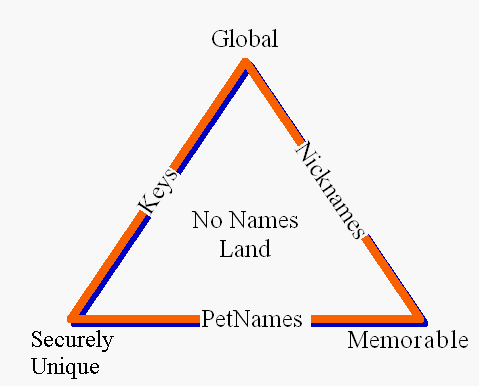
The PetName system allows unique, global, and memorable identifiers by using trusted relationships.
The metatheory extrapolates well whether you use the example of preventing paypal phishing, or apply the theory to purchase recommendations.
TalkDigger is a great tool that lets you search conversations about a specific URL.

This is a metasearch that covers Technorati, Google Blog, Bloglines, Feedster, BlogDigger, Icerocket, MSN Search, Google, Yahoo!
You can outuput the results as an RSS feed to keep track of your sites and stay involved in the conversation.
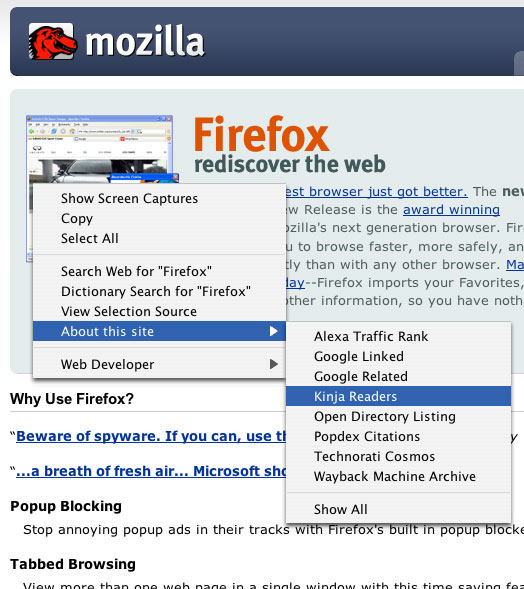
“About This Site” is a plugin for Firefox that makes it easy to check:
* Alexa traffic detail and related sites
* Del.icio.us linkbacks
* Google related pages, cache and link information
* Kinja site readers
* Netcraft reports
* Open Directory site listing
* Popdex search for citations
* Technorati link cosmos
* Wayback Machine archive
* Whois query
* Yahoo linkdomain
This plugin to show metadata is very useful for SEO as well as SEM.
One of my friends takes great joy in tormenting Google cheerleaders. He likes to say things like “I’m going to use Yahoo, it’s the best search engine”, or “I’m going to Yahoo for it, that way I will actually find it”. When he wants to find something Y! is the first place that he goes.
What makes this funy is that he makes a good part of his living through “creative search engine marketing” and is generally much more able to game Yahoo than Google.
But now it looks like a lot more people may be thinking his way. Yahoo has launched personalized social search.
Save to My Web is a simple, sociable button you can add to any and every page of your blog or website. Users click to save your content and add it directly to their stored pages on My Web 2.0. From there, the page is easy to retrieve, and easy to share with others. …
By distributing the tagging/microchunking of content to it’s users, Yahoo goes from search & communities (Y! groups) to search + communities + reconstructor. This could be the missing piece for the Yahoo triple play, a la Media 2.0 Strategic Maxims.
via John Battelle’s Searchblog
SEOmoz | Search Engine Ranking Factors
Here is a list of factors in SERPs, aggregated & weighted by a very respectable group of SEOs. Excellent reference for SEO.
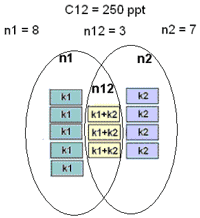
Targeting Documents and Terms Through Co-Occurrence Datais a paper written by Dr. Garcia. In which he explains in detail how to choose which keyword in a two term phrase to focus on for SEO.
By way of example the phrase “car insurance” is analyzed, with the end result showing that it is better to target “insurance” as opposed to “car”.
Thus by focusing your efforts on the less competitive term, you can maximize your optimization for the two term keyphrase.
“Work It Harder Make It Better Do It Faster, Makes Us stronger” DaftPunk
Looking at revenues & users for Ebay, Yahoo & Google is where new media economics really begins to come into it’s own. This is web 2.0 theory being proven in the market today.
Times of great change mean times of great opportunity.
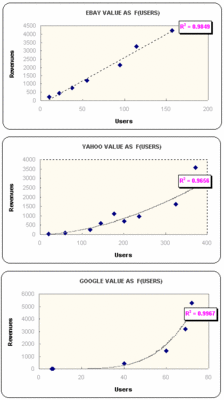
Web 2.0 is a shift to from tight, hierarchical architectures which realize exponential network FX, to loosely structured architecture which realize combinatorial network FX.
More simply, Web 2.0 is about the shift from network search economies, which realize mild exponential gains – your utility is bounded by the number of things (people, etc) you can find on the network – to network coordination economies, which realize combinatorial gains: your utility is bounded by the number of things (transactions, etc) you can do on the network.
via bubblegeneration – strategy, business models, and innovation
Jeff from BuzzMachine says:
Who wants to own content?
Distribution is not king.
Content is not king.
Conversation is the kingdom.
The war is over and the army that wasn’t even fighting — the army of all of us, the ones who weren’t in charge, the ones without the arms — won. The big guys who owned the big guns still don’t know it. But they lost.
In our media 2.0, web 2.0, post-media, post-scarcity, small-is-the-new-big, open-source, gift-economy world of the empowered and connected individual, the value is no longer in maintaining an exclusive hold on things. The value is no longer in owning content or distribution.
The value is in relationships. The value is in trust.
– Link
Trust in network environments
The need for a cognitive model of trust
The socio-cognitive model of trust
The beliefs of trust: what X thinks about Y
The “Motivation belief” of trust
Yin-yang trust
Internal and external trust
The sources of trust
Trust and irrationality
Degrees of trust
Trust and risk
Trust and delegation
Trust and control
Trust and adjustable autonomy
The dynamics of trust
Trust and experiences
Trust elicits trust
Trust atmosphere
Trust as a three parties relationship: contracts and authorities
Trust as a communicative act
Trust as a fuzzy network
Trust in contract nets
Trust, security and technology
Trust and technical knowledge
Trust and knowledge management