Perspective based Value
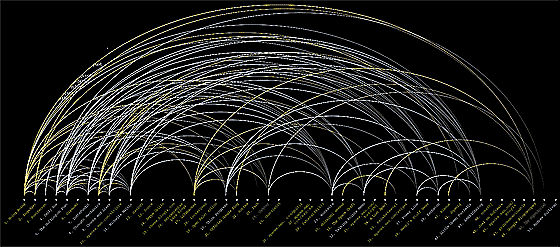
Linkology is the “50 most linked to blogs relate” according to data derived from Technorati. What makes this interesting, is the implied assumption that these are 50 of the most important blogs. When looked at from an SEO perspective, then the value is relatively obvious. However when looked at from a PR and/or effective reach [...]

Monetizing Communities – Group Forming Networks maximize per user value

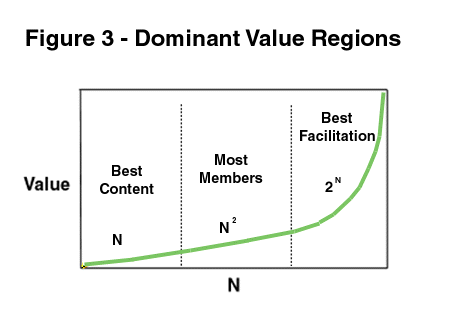
Previously I referenced the value of trust. Idea – The more a network facilitates trust, the easier it is for network users to form groups. From David Reed re: The Power of Community Building Group Forming Networks maximize per user value and the dominant value in a typical network tends to shift from one category [...]

MMO games are formalized reputation economies

Trust + MMORG = Reputation Economy new reputation economies will pervasively reshape culture as dramatically as the invention of money. Entirely novel kinds of human interaction will spawn new social classes, power structures and lifestyles. Reputation economies will be abstractions of relationships, in the same way that money abstracts material wealth and labor. >

Media 2.0 Strategic Maxims

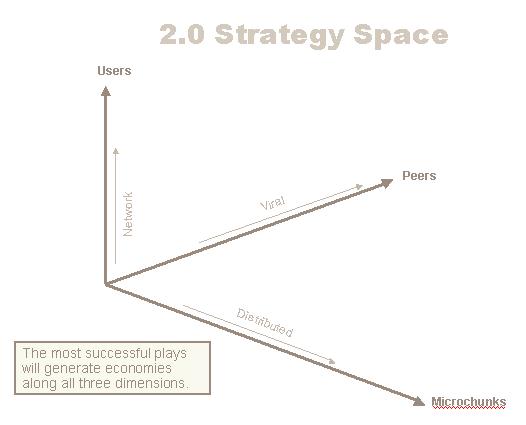
From Bubblegeneration we get what I am calling the Media 2.0 maxims. 1) Network economies dominate search. 2) Viral economies dominate microcontent/communities. 3) Distributed economies dominate personalization/microchunking. The point is that if you can put all three together, you realize a *huge* scale advantage, because you’re realizing nonlinear returns to scale along all three dimensions.

New Media Economics Today

“Work It Harder Make It Better Do It Faster, Makes Us stronger” DaftPunk

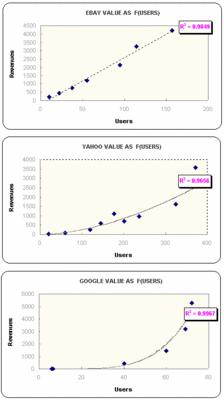
Looking at revenues & users for Ebay, Yahoo & Google is where new media economics really begins to come into it’s own. This is web 2.0 theory being proven in the market.

Times of great change mean times of great opportunity.


Web 2.0 is a shift to from tight, hierarchical architectures which realize exponential network FX, to loosely structured architecture which realize combinatorial network FX.

More simply, Web 2.0 is about the shift from network search economies, which realize mild exponential gains – your utility is bounded by the number of things (people, etc) you can find on the network – to network coordination economies, which realize combinatorial gains: your utility is bounded by the number of things (transactions, etc) you can do on the network.

Trust is not Trusted Computing


While I have written about
The Vaulue of Trust before, trusted computing is entirely different.

This incredible short is both a beautiful example of messaging as well as a good explanation about some of the issues with trusted computing.

watch it now

After watching that, it’s an ideal time to enjoy reading the story
0wnz0red to take your understanding to another level.


Via Boing Boing

Copy Optimized- DVDA & more

Metadata that reconstructs the file via the web – exactly what we need these days. The more granular content gets the better this works.

There needs to be a standard so that it’s completely unambiguous just what one means when one says “Copy Optimized DVD Audio disc”. It’s that clear specification that will make embedded players and perfect peer-to-peer network copies possible. A disc containing such files could be popped into your home stereo DVD player and made to play, copy and share with no more user intervention than hitting a button…

But here’s the key: each file will be named in a way that’s optimized for file sharing, with artist, album, title and track number right in the filename, and with all the right metadata already embedded in the file when the album was mastered at the studio. To share Copy Optimized music you just direct your peer-to-peer filesharing application to your DVD drive so it will share what you’re listening to, have your friends copy the tracks onto their computers’ hard drives, or else burn them copies of the whole DVD.

But wait: there’s more! The DVD disk itself will have a metadata file in its root directory that will specify the contents of the entire disk. My idea is that one could make a bit-for-bit reconstruction of the whole disk just by grabbing this one metadata file and then looking for the tracks on the file sharing networks. This file would be one or two kilobytes of XML that would have each track’s metadata as well as its Secure Hash Algorithm checksum so it can be uniquely identified over the net.

Via Boing Boing

It’s the relationship

Working for AVN in the Adult Entertainment Industry teaches you the value of relationships. The AVN media network spans magazines, tradeshows, and websites. IMHO the following quote applies to all of them:

“The relationship the magazine has with readers — and, more important, that readers have with readers — is at least as valuable as the magazine’s content. That’s a lesson.”

Originally
by Jeff from BuzzMachine
at September 1, 2005, 16:58

The Value of Trust

Who wants to own content?

Distribution is not king.

Content is not king.

Conversation is the kingdom.

The war is over and the army that wasn’t even fighting — the army of all of us, the ones who weren’t in charge, the ones without the arms — won. The big guys who owned the big guns still don’t know it. But they lost.

In our media 2.0, web 2.0, post-media, post-scarcity, small-is-the-new-big, open-source, gift-economy world of the empowered and connected individual, the value is no longer in maintaining an exclusive hold on things. The value is no longer in owning content or distribution.

The value is in relationships. The value is in trust.

::::

Information wants to be free while trust wants to be earned.

We pay attention to those that we trust.

Trust
in network environments

The need for a
cognitive model of trust

The socio-cognitive
model of trust

The beliefs of
trust: what X thinks about Y

The
“Motivation belief” of trust
Yin-yang trust
Internal
and external trust

The sources of
trust

Trust and
irrationality

Degrees of trust
Trust and risk
Trust and
delegation

Trust and control
Trust and
adjustable autonomy

The dynamics of
trust

Trust and
experiences

Trust elicits
trust

Trust
atmosphere

Trust as a three
parties relationship: contracts and authorities

Trust as a
communicative act

Trust as a fuzzy
network

Trust in
contract nets

Trust, security
and technology

Trust and
technical knowledge

Trust and
knowledge management