Jeff Random - new media and metatheory remix

Positive living

Randy Pausch gives an incredibly inspiring final lecture. This is a great example of the economics of abundance in action.

The link is to the full version of his talk. You may want to skip to 2:15 in, however, the full version (as opposed to highlights) is an incredibly well spent hour and a half.

We are the web

“We”ll need to rethink a few things
copyright
authorship
identity
ethics
aesthetics
rhetoric
governance
privacy
commerce
love”

From this excellent video


Sounds exactly like what we should be considering regarding a singularity.

There is only one time in the history of each planet when its inhabitants first wire up its innumerable parts to make one large Machine. Later that Machine may run faster, but there is only one time when it is born.

You and I are alive at this moment.

KK for Wired

Program Yourself


Program yourself. Make sure that you have the volume turned up.

Mainstream Crossover Porn Sensibility

This fantastic video

Whos Your Daddy?
is an deft piece using the long standing adult industry marketing tradition of parody in reverse. In this case it self referentially honors and adds new media production values to adult marketing archetypes.

The site itself is a great example of what mainstream can learn from the adult industry. The site uses ‘traditional’ adult internet marketing tools, to produce an innovative mainstream offering.

This includes a warning page with age verification, the equivalent of a Free Hosted Gallery (FHG), sample movie etc. the only thing missing was a join page link.

Whos Your Daddy Gallery
If they were an affiliate program I would send traffic to them.

Perspective based Value

Linkology

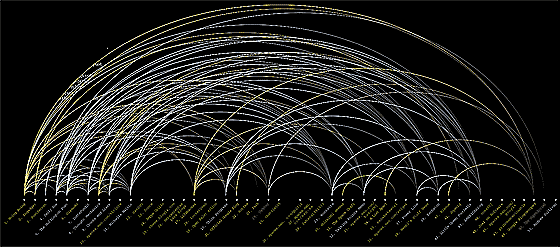
Linkology is the “50 most linked to blogs relate” according to data derived from Technorati. What makes this interesting, is the implied assumption that these are 50 of the most important blogs.

When looked at from an SEO perspective, then the value is relatively obvious. However when looked at from a PR and/or effective reach perspective then suddenly the value plummets. Part of that is audience fragmentation although that would compare well with relevancy in SEO.

Going down the list, you can almost hear the apologist defences for why some of the sites are on the list. However, at the same time, these are the sites dominating Technorati.

If you are selling advertising for one of these sites, then being able to say you are the # most linked blog certainly is a useful way to raise the percieved value in the mind of a semi niave potential advertiser. Of course if you are able to command a certain price for it, then regardless of how well informed a buyer you have established a true market value.

The takeaway? Sometimes by making people think a resources is valuable, it actually becomes valuable. This is even easier to exploit when you have single source metrics.

Secure, Memorable & Global

Making your brand Secure, Memorable, and Global sounds like what an IP firm, and or marketing agency should do for you. As domain names = brands more and more it’s also the properties that you would like to have your indentifier (brand and/or URL) have on the internet.

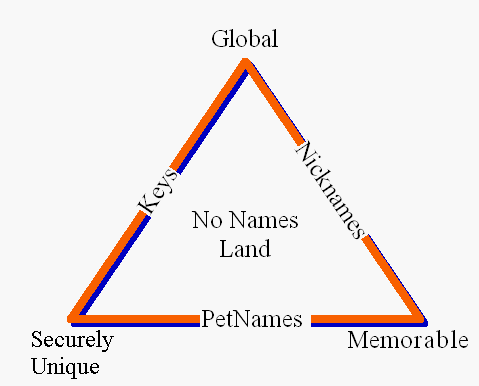
Up until now Zooko’s Triangle has argued for ‘choose any two’ in the same way that you can generally ‘choose any two’ amongst Good, Fast & Cheap.

Now Marc Steigler suggests a system for making “secure, memorable, and global identifiers to use on the Internet”

PetNames

The PetName system allows unique, global, and memorable identifiers by using trusted relationships.

The metatheory extrapolates well whether you use the example of preventing paypal phishing, or apply the theory to purchase recommendations.

Viral Marketing Example

Viral content is content that consumers want to propogate, in essence creating word of mouth marketing (WOMM).

Roundabout is a great example of a viral marketing video for this crossfader.

Media 2.0 Strategic Maxims

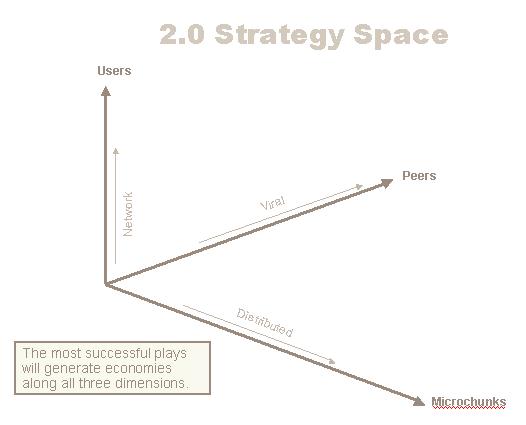
From Bubblegeneration we get what I am calling the Media 2.0 maxims.

1) Network economies dominate search.

2) Viral economies dominate microcontent/communities.

3) Distributed economies dominate personalization/microchunking.

The point is that if you can put all three together, you realize a *huge* scale advantage, because you’re realizing nonlinear returns to scale along all three dimensions.

What Is Web 2.0 ?

O’Reilly talks about What Is Web 2.0, including these Web 2.0 Design Patterns

1 The Long Tail
Small sites make up the bulk of the internet’s content; narrow niches make up the bulk of internet’s the possible applications. Therefore: Leverage customer-self service and algorithmic data management to reach out to the entire web, to the edges and not just the center, to the long tail and not just the head.

2 Data is the Next Intel Inside
Applications are increasingly data-driven. Therefore: For competitive advantage, seek to own a unique, hard-to-recreate source of data.

3 Users Add Value
The key to competitive advantage in internet applications is the extent to which users add their own data to that which you provide. Therefore: Don’t restrict your “architecture of participation” to software development. Involve your users both implicitly and explicitly in adding value to your application.

4) Network Effects by Default
Only a small percentage of users will go to the trouble of adding value to your application. Therefore: Set inclusive defaults for aggregating user data as a side-effect of their use of the application.

5 Some Rights Reserved.
Intellectual property protection limits re-use and prevents experimentation. Therefore: When benefits come from collective adoption, not private restriction, make sure that barriers to adoption are low. Follow existing standards, and use licenses with as few restrictions as possible. Design for “hackability” and “remixability.”

6 The Perpetual Beta
When devices and programs are connected to the internet, applications are no longer software artifacts, they are ongoing services. Therefore: Don’t package up new features into monolithic releases, but instead add them on a regular basis as part of the normal user experience. Engage your users as real-time testers, and instrument the service so that you know how people use the new features.

7 Cooperate, Don’t Control
Web 2.0 applications are built of a network of cooperating data services. Therefore: Offer web services interfaces and content syndication, and re-use the data services of others. Support lightweight programming models that allow for loosely-coupled systems.

8 Software Above the Level of a Single Device
The PC is no longer the only access device for internet applications, and applications that are limited to a single device are less valuable than those that are connected. Therefore: Design your application from the get-go to integrate services across handheld devices, PCs, and internet servers.


Intriguing Interface

The Billy Harvey website - clever, understated, technically brilliant. Hat’s off to SoFake.

Billyharvey

Via Creating Passionate Users

Next Page »